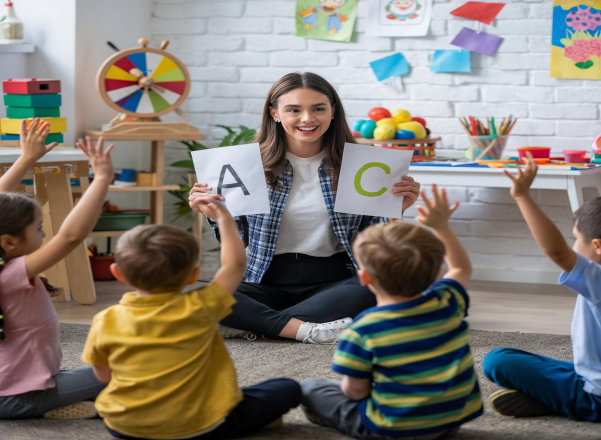
Individualized Special Education Program Prepares Your Child for Life
-
Proven teaching strategies
-
Safe and secure environment
-
Focus on all aspects of personal development
Choose the Best Education for your Special Child
Better life child Development center aims to develop your child’s potential to its fullest.
Our special educator identifies your child’s preferred learning style and plans on a learning program and teaching methodology that best suits his/her abilities and interests. Our program opens up channels and changes the learning experience of your child.
Our Special Education Dept. Service
Our special educators provide individualized education program to attend to the academic, cognitive, motor, social and emotional needs of children above 3 years. Individual and/or group programs are planned keeping in mind your child’s level. Our services include,
a. Special Education for kids with Autism
-
Assessing individual needs*: Identifying strengths, challenges, and learning styles.
-
Creating IEPs: Setting personalized goals and strategies.
-
Structured teaching: Breaking tasks into manageable steps.
-
Positive reinforcement: Encouraging desired behaviours.
-
Social skills training: Teaching social cues and interactions.
-
Play-based learning: Using play to develop social and communication skills.
-
Visual aids: Using pictures, schedules, and stories to support understanding.
-
Daily living skills: Teaching self-care and independence skills.
b. Special Education for kids with Intellectual Disabilities.
-
Individualized Education Plan (IEP) – Design a custom plan with goals matching their abilities and needs.
-
Functional Skill Training – Teach daily living skills like dressing, eating, hygiene, and money handling.
-
Adaptive Curriculum – Modify academic content to match learning pace (e.g., simplified math, life-skills literacy).
-
Behavioural Support* – Use positive reinforcement and behaviour modification techniques.
-
Social Skills Programs* – Practice interaction, communication, and peer relations through role-play and group activities.
-
Therapeutic Collaboration* – Work with speech, occupational, and physical therapists for holistic growth.
-
Family Training & Counselling – Educate caregivers on strategies to continue support at home.
-
Task Analysis– Break complex skills into step-by-step
c. Special Education for children with Down’s Syndrome.
-
Individualized Education Plans (IEPs): Tailored plans addressing specific needs and goals.
-
Early Intervention: Early childhood programs focusing on cognitive, motor, and social skills.
-
Inclusive Classrooms: Supporting socialization and academic growth in mainstream settings.
-
Visual Aids: Using pictures, schedules, and stories to support understanding.
-
Structured Teaching: Breaking tasks into manageable steps.
-
Positive Reinforcement: Encouraging desired behaviours.
-
Social Skills Training: Teaching social cues and interactions.
d. Special Education for kids with Learning Disability.
-
Assess and Identify Needs: Pinpoint specific learning challenges (e.g., dyslexia, dysgraphia).
-
Individualized Education Plans (IEPs): Customized plans with targeted goals and strategies.
-
Specialized Instruction: One-on-one or small group teaching using multisensory methods.
-
Accommodations and Modifications: Providing extra time, assistive tech, or adapted materials.
-
Multisensory Learning: Engaging multiple senses (visual, auditory, kinaesthetic) to reinforce learning.
-
Progress Monitoring: Regularly tracking progress and adjusting strategies.
-
Phonological Awareness: Building sound-letter connections for reading.
-
Visual Aids: Using graphic organizers, charts, and pictures.
-
Structured Teaching: Breaking tasks into manageable steps.
e. Special Education for children with ADHD.
-
Behavioural Interventions*: Positive reinforcement, behaviour modification, and classroom management.
-
Individualized Education Plans (IEPs): Tailored plans addressing specific needs and goals.
-
Structured Environment: Organized classrooms with clear routines and minimal distractions.
-
Seating Arrangements: Strategic seating to minimize distractions.
f. Special Education for kids with developmental delay.
-
Early Intervention: Identify and address delays in infants and toddlers.
-
Therapeutic Services: Occupational, speech, and physical therapy to support development.
-
Adaptive Learning: Modify activities to match their learning style and pace.
-
Social Skills Training: Teach social interactions, play, and communication skills.
-
Break Tasks into Steps: Simplify complex tasks into manageable parts.
-
Use Visual Aids: Pictures, schedules, and stories to support understanding.
-
Positive Reinforcement: Encourage desired behaviours and efforts.
g. Special Education for slow learners.
-
Assess Learning Style: Identify how they learn best (visual, auditory, kinaesthetic).
-
Individualized Education Plans (IEPs): Customized plans with achievable goals.
-
Repetition and Practice: Break concepts into smaller chunks, repeating and reinforcing learning.
-
Multisensory Approaches: Engage multiple senses to reinforce understanding.
-
Paced Learning: Allow them to learn at their own speed without pressure.
-
Visual Aids: Use pictures, diagrams, and charts to support understanding.
-
Hands-on Activities: Practical, experiential learning.
-
Positive Feedback: Encourage efforts and progress.
-
Adaptive Technology: Tools like text-to-speech software or educational apps.
For children above 15 years, we assist with functional academics to make them functionally independent in the environment.